
Textiles & Craft
Calico cotton cloth
by 11th-12th c. CEIndian weaversHemachandra's mentionPan-Indian / unspecified
1001
Plain or printed cotton cloth originating around Kozhikode (Calicut), from which the name derives.
- Dated
- 1001–1200
- As scholars put it
- by 11th-12th c. CE
- Originator
- Indian weavers
- Source text
- Hemachandra's mention
- Region
- Pan-Indian / unspecified
- Discipline
- Textiles & Craft
- Evidence
- Documented
- Confidence
- High
- Verification
- Reference-cited
Meanwhile in the West
Hugely popular in Europe from the 17th c. (and later imitated industrially).
Fair to say
'Calico' is a fabric type/trade good, named after Calicut.
Path to modern innovation
A foundational cotton textile in global trade.
Builds on
 5,000 BCE
 1,500 BCE
Transmission
Exported to Africa, Egypt and then Europe.
- Gujarat, 13th c. CE.
Printers stamp cotton with carved wooden blocks and fix the colours with mordants, so the dyes survive washing.
- Fustat (Old Cairo), 13th-15th c. CE.
Fragments of Gujarati printed cottons survive in the rubbish heaps of Fustat, carried there by Indian Ocean merchants.
- Calicut (Kozhikode), 1498 CE.
Portuguese ships reach this Malabar port. Europeans name the cotton cloth they buy after it: calico.
- London, 1700 CE.
Indian cottons become so fashionable that Parliament restricts them in the Calico Acts of 1700 and 1721, to protect English wool and silk.
- Manchester, c. 1780 CE.
Spinning machines copy Indian cloth at industrial scale. Cotton drives the Industrial Revolution, while India's own weavers lose their markets.
Museum objects
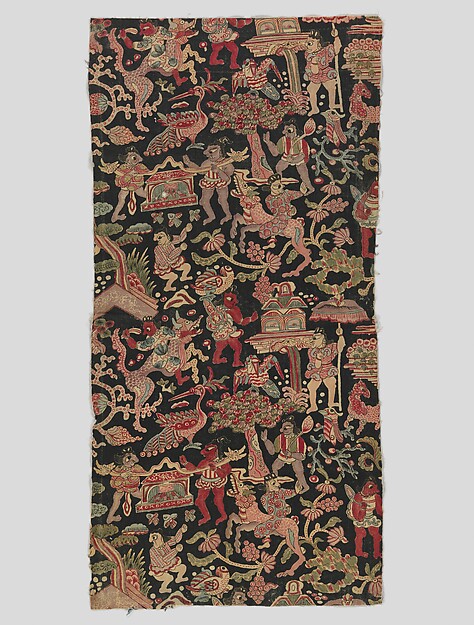 Sarasa with Figures, Birds, and Fantastic AnimalsUnreviewed
 Textile Panel of ChintzUnreviewed
 Painted Textile Depicting Celestial MusiciansUnreviewed
References
- 1Encyclopaedia Britannica: calico
Further reading
Related
Corrections and additional sources: edit IND-113 on GitHub.